
Judiciary Exam Syllabus:
Beyond the Bare Acts
In2Law Academy · Published 9 July 2026 · 3 min read
Most aspirants preparing for the judiciary exam syllabus assume it begins and ends with civil law, criminal law, and procedure. That's only the surface, and treating it as the whole picture is exactly what costs strong candidates their rank.
Beyond the Bare Acts
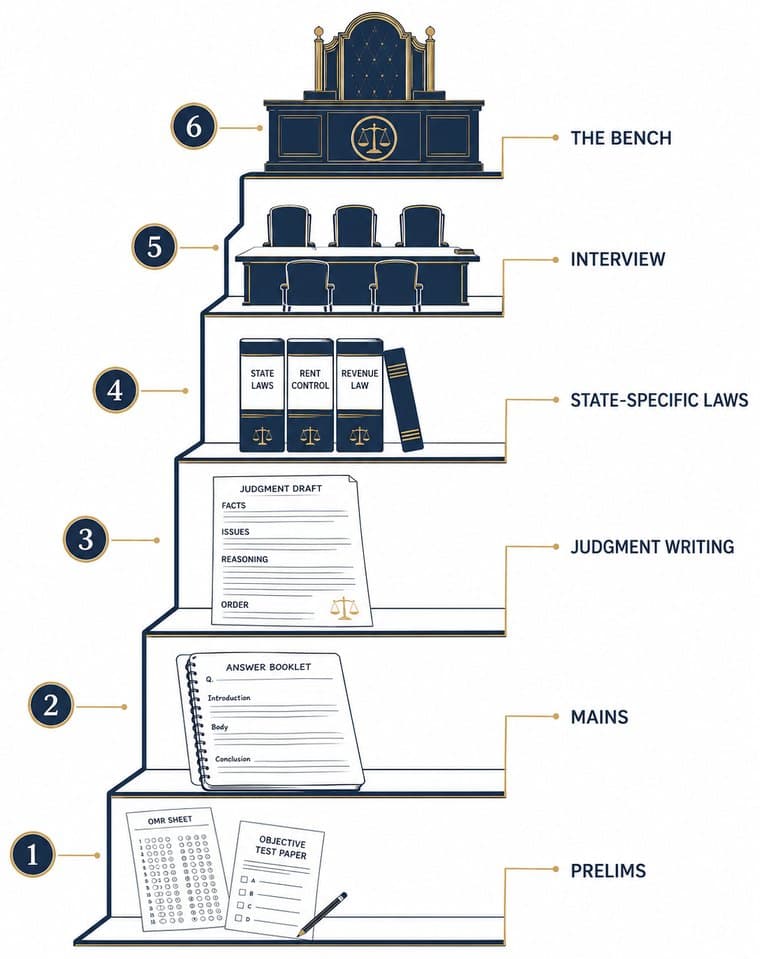
The judiciary exam tests legal knowledge, written application, state law, language, interview readiness, and the judgment expected from a future judge.
The exam has three stages, and each tests something different
Myth
The syllabus is just civil law, criminal law, and procedure.
Reality
The civil judge exam typically runs through Prelims, Mains, and an Interview. Prelims is objective, checking legal knowledge alongside current affairs and general awareness. The judiciary Mains paper goes further, testing judgment writing, procedural application, and language proficiency, often requiring answers in the state's own regional language.
Judgment writing is a skill, not a memory exercise
Myth
Judgment writing is just another topic to memorize.
Reality
Several state judiciary exams, including Chhattisgarh and Haryana, include a dedicated paper focused almost entirely on framing issues or writing full judgments. This isn't about reciting sections from a bare act, it's about applying law to a specific fact pattern the way a judge actually would.
Central acts don't cover the full state judiciary syllabus
Myth
Central acts cover everything you need.
Reality
Every state layers its own legislation on top of central law. Maharashtra's judiciary syllabus includes the Maharashtra Rent Control Act and mandates proficiency in Marathi. Rajasthan and Uttar Pradesh similarly test state specific acts alongside constitutional and procedural law.
The interview has no fixed syllabus, but it isn't random
Myth
The interview is unpredictable, so there's nothing to prepare.
Reality
Panels consistently assess composure under pressure, real world judgment, and how a candidate reasons through practical scenarios, not just legal recall. This stage rewards candidates who understand the profession, not just the exam.
At In2Law, the Judiciary program is led by practising lawyers who prepare candidates for all three stages, not just the written papers.